
How to Build a Patient-Focused Content Plan for Your Healthcare Practice
A practical guide to healthcare content marketing, patient engagement, SEO, social media strategy and digital growth for hospitals, clinics and healthcare businesses in India.
A well-planned healthcare content marketing strategy helps medical practices communicate with their target audience, answer common patient questions, improve search engine visibility and generate relevant enquiries.
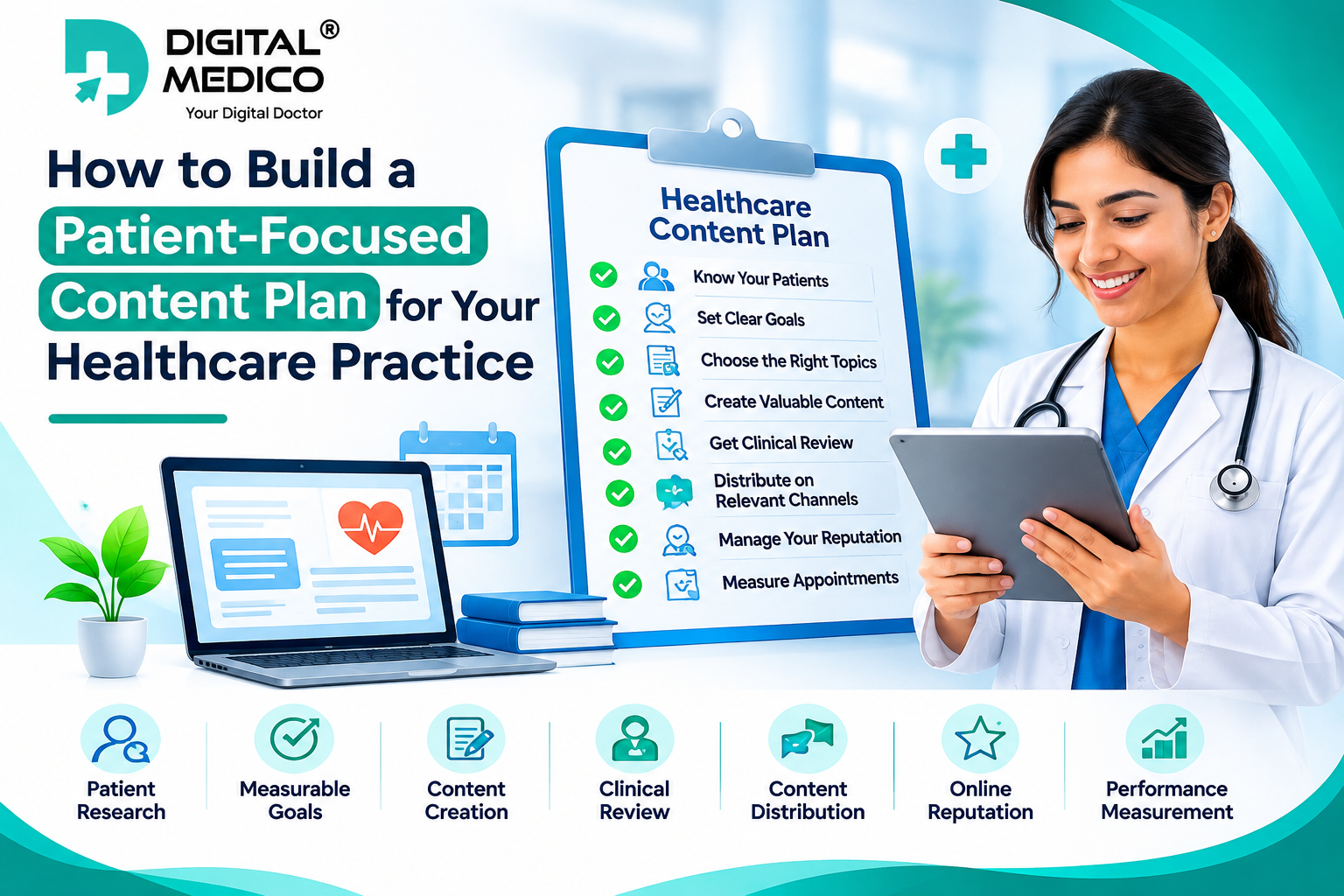
However, successful healthcare content marketing requires more than publishing regular blog posts or social media updates. It involves understanding patient needs, setting measurable goals, selecting relevant topics, creating accurate content, reviewing medical information and tracking actual business results.
Digital Medico specialises in digital marketing for the medical and healthcare sector. Through healthcare-focused digital strategies, we help healthcare businesses strengthen their online presence and connect with their target audiences.
Explore our Healthcare Digital Marketing Services to understand how specialised digital marketing can support your healthcare business.
Key Takeaways
- Understand your patients before creating content.
- Establish measurable healthcare marketing goals.
- Choose topics based on real patient questions.
- Create educational and informative healthcare content.
- Ensure medical content receives qualified clinical review.
- Follow applicable healthcare advertising and privacy regulations.
- Distribute content through relevant digital platforms.
- Measure appointments and business outcomes instead of focusing only on website traffic.
1. How Do You Research Patients and Set Goals for Your Healthcare Marketing Plan?
The first step in building a successful healthcare content plan is understanding your patients and identifying what they are searching for.
Every healthcare practice serves different audiences. A dental clinic, hospital, diagnostic laboratory and physiotherapy centre will have different patient requirements.
Understanding these differences helps create relevant content.
Understand Your Target Patients
Start by collecting information from existing patient interactions and business records.
- Frequently asked questions received by reception teams.
- Patient enquiries and appointment requests.
- Website enquiry forms.
- Online reviews and feedback.
- Common healthcare service enquiries.
- Google Search Console performance data.
- Local search trends.
For example, a dental clinic may receive repeated questions about root canal treatment, dental implants, tooth sensitivity and preventive dental care.
These questions can become useful blog topics, educational videos and website FAQs.
Identify Patient Requirements
Divide your target audience according to their healthcare requirements.
- Patients looking for general medical consultations.
- Parents searching for paediatric healthcare services.
- Individuals researching dental treatments.
- Patients looking for diagnostic testing.
- People searching for physiotherapy and rehabilitation.
- Families comparing hospitals and healthcare facilities.
Set Measurable Healthcare Marketing Goals
After identifying your audience, establish measurable objectives.
- Increase organic website traffic.
- Improve rankings for relevant healthcare keywords.
- Generate more qualified appointment enquiries.
- Improve visibility in local search results.
- Increase engagement with educational content.
- Strengthen the online reputation of your healthcare practice.
Every objective should have a measurable baseline, a responsible team member and a review schedule.
2. How Do You Choose Healthcare Content Topics Patients Are Searching For?
Choosing the right content topics is one of the most important parts of healthcare content marketing.
Instead of publishing random articles, focus on questions that patients regularly search for.
Research Patient Questions
Collect common questions from reception staff, healthcare professionals, website enquiries and online feedback.
For example, a healthcare practice may identify the following topics:
- What are the common symptoms of diabetes?
- When should someone consult a dentist?
- What is the difference between physiotherapy and rehabilitation?
- Why are regular health checkups important?
- What should patients know before a medical procedure?
- How can patients prepare for a diagnostic test?
These topics can help build an informative content library.
Use Healthcare SEO Keyword Research
Keyword research helps identify the search terms people use when looking for healthcare information.
- Healthcare service keywords.
- Location-based medical keywords.
- Treatment-related search queries.
- Common symptom-related questions.
- Informational long-tail keywords.
- Frequently asked healthcare questions.
For better search visibility, organise keywords according to search intent and the healthcare services offered by your practice.
Explore SEO and Digital Marketing Services from Digital Medico to understand how keyword research, website optimisation and search visibility contribute to digital growth.
Map Content to the Patient Journey
| Patient Stage | Patient Requirement | Suggested Content |
|---|---|---|
| Awareness | Understand symptoms and healthcare topics. | Educational blogs, awareness articles and videos. |
| Consideration | Understand available treatments and services. | Procedure explainers, treatment information and FAQs. |
| Decision | Find relevant doctors, clinics and hospitals. | Service pages, doctor information and appointment details. |
| Retention | Access follow-up and educational information. | Approved care instructions, newsletters and wellness resources. |
3. How Do You Create Clear, Accurate and Patient-Friendly Healthcare Content?
Healthcare content should be informative, understandable and appropriate for its intended audience.
Medical terminology can sometimes be difficult for general readers. Therefore, use simple language and explain technical terms wherever necessary.
Choose the Right Content Formats
Different patients prefer different ways of consuming information.
Healthcare Blog Articles
Publish informative articles about healthcare services, common patient questions, preventive care and general medical education.
Short-Form Videos
Create educational videos and short-form content for social media platforms.
Infographics
Use simple visual explanations to communicate healthcare information.
Frequently Asked Questions
Answer common patient questions through dedicated FAQ sections.
Educational Social Media Posts
Share useful healthcare information through Instagram, Facebook and other relevant platforms.
Maintain Consistent Content Quality
Every article or post should have:
- A clear and informative title.
- Relevant healthcare information.
- Easy-to-understand language.
- Proper headings and structure.
- Reliable supporting references where appropriate.
- A relevant description and keyword strategy.
- A qualified medical review where necessary.
Explore Content Marketing Strategy Services to learn how audience research, content creation, distribution and performance measurement can support a structured content plan.
4. Why Is Clinical Review Important Before Publishing Healthcare Content?
Healthcare content requires additional attention because inaccurate information can create confusion and potential patient-safety risks.
Before publishing medical information, establish a review process involving qualified healthcare professionals.
Important Clinical Review Requirements
A qualified clinician should review relevant medical content for:
- Accuracy of medical information.
- Treatment-related claims.
- Medicine information and dosage details.
- Contraindications and safety warnings.
- Emergency guidance and relevant warning signs.
- Clarity of medical terminology.
- Publication and review dates.
Treatment and medicine-related information may require more frequent reviews than general healthcare awareness articles.
Use Patient-Friendly Language
Avoid unnecessarily complicated medical terminology.
For example, when explaining a medical procedure, describe its purpose, general process and relevant considerations in language that patients can understand.
The objective should be to educate readers rather than make unsupported promises.
5. What Do NMC, ASCI and the DPDP Act Mean for Healthcare Content Marketing in India?
Healthcare marketing in India requires careful attention to professional guidelines, advertising standards and personal data protection requirements.
Healthcare organisations should review applicable regulations before publishing promotional or patient-related content.
NMC Guidelines
Medical professionals and healthcare organisations should consider applicable National Medical Commission guidelines when communicating medical services.
Avoid:
- Exaggerated medical claims.
- Guaranteed treatment outcomes.
- Unsupported claims of superiority.
- Improper patient solicitation.
- Inappropriate patient testimonials.
- Publishing identifiable patient information without an appropriate legal basis.
ASCI Advertising Standards
The Advertising Standards Council of India promotes truthful and responsible advertising.
Healthcare-related promotional claims should be accurate, substantiated and not misleading.
Digital Personal Data Protection Act
The Digital Personal Data Protection Act, 2023, introduces requirements relating to the processing of digital personal data.
Healthcare businesses should pay attention to:
- Appropriate notices and lawful processing.
- Patient data privacy.
- Marketing consent requirements.
- Data security.
- Appropriate handling of personal information.
- Opt-out and communication preferences where applicable.
Patient information collected for healthcare purposes should not automatically be reused for unrelated marketing activities.
Consent alone does not make otherwise prohibited advertising acceptable.
Healthcare businesses should obtain appropriate professional legal guidance and verify applicable regulations and commencement requirements before implementing their marketing processes.
6. Where Should Healthcare Businesses Publish Their Content?
Publishing content on the right platforms helps healthcare businesses reach their intended audiences.
However, every platform serves a different purpose.
Google Search and Google Business Profile
Google Search helps patients discover relevant healthcare information, doctors, clinics and hospitals.
A properly maintained Google Business Profile helps healthcare businesses provide accurate information about their location, contact details, services and operating hours.
YouTube Marketing
YouTube is useful for educational healthcare videos, procedure explanations and general medical awareness content.
Long-form videos can help explain topics that require additional information.
Instagram Marketing
Instagram supports visual communication through educational posts, short videos, carousels and stories.
It can be useful for healthcare awareness and service-related information.
Facebook Marketing
Facebook can help healthcare businesses communicate with local communities and share educational information.
WhatsApp Business
WhatsApp Business can support appropriate patient communication, enquiries, reminders and follow-up information, subject to consent and privacy requirements.
LinkedIn Marketing
LinkedIn can help healthcare organisations build professional relationships, share industry information and connect with healthcare professionals.
Build a Consistent Social Media Strategy
Rather than publishing randomly, create a monthly content calendar that includes educational articles, awareness posts, videos and relevant updates.
Learn more about Social Media Marketing Services offered by Digital Medico.
7. How Can Healthcare Businesses Manage Their Online Reputation?
Online reputation plays an important role in how patients evaluate healthcare providers.
Patients may research a clinic or hospital before deciding whether to contact it.
Therefore, healthcare businesses should monitor their online presence and maintain accurate business information.
Maintain Accurate Business Information
Check that your business information is consistent across relevant platforms.
- Healthcare business name.
- Address and location.
- Contact information.
- Working hours.
- Website URL.
- Relevant healthcare services.
Monitor Patient Feedback
Monitor online reviews and feedback to identify recurring concerns and opportunities to improve patient communication.
Respond professionally and protect patient privacy.
Handle Negative Reviews Carefully
- Remain professional.
- Avoid arguments.
- Thank the reviewer for sharing feedback.
- Do not confirm or deny that the reviewer is a patient.
- Never disclose medical information.
- Provide an appropriate private contact channel.
Healthcare businesses should follow applicable professional rules and platform policies when requesting or responding to reviews.
Digital Medico focuses on helping healthcare practices strengthen their digital visibility and online reputation through healthcare-focused marketing activities.
Learn more about Digital Medico and its healthcare marketing approach.
8. How Do You Measure Healthcare Content Marketing Performance?
Publishing content regularly is not enough. Healthcare businesses must measure whether their marketing activities are achieving meaningful results.
Website traffic and social media engagement are useful indicators, but they should not be the only performance measures.
Track Important Healthcare Marketing KPIs
| Performance Area | Important Metrics |
|---|---|
| Website Performance | Organic website traffic, search impressions, keyword ranking performance and website engagement. |
| Enquiry Performance | Qualified website enquiries, appointment requests, contact form submissions and relevant phone enquiries. |
| Social Media Performance | Post engagement, video views, audience growth, content reach and relevant enquiries. |
| Business Performance | Completed appointments, cost per acquired patient, patient reactivation rate and enquiry-to-appointment conversion. |
Use appropriate analytics and business records to evaluate these metrics.
Review Performance Monthly
A monthly review helps identify which content topics attract relevant visitors and which pages require improvement.
- Identify articles generating relevant organic traffic.
- Review pages receiving impressions but few clicks.
- Identify content generating enquiries.
- Update outdated information.
- Improve pages that do not meet user expectations.
Improve the Strategy Quarterly
Every three months, review the overall performance of your content plan.
Decide which topics should be expanded, refreshed or discontinued.
The objective is to build a consistent healthcare content strategy that supports meaningful business outcomes.
Where Does a Specialist Healthcare Digital Marketing Partner Fit In?
Managing healthcare marketing requires knowledge of digital platforms, search engine optimisation, content development, social media management and online reputation.
Smaller healthcare practices may manage initial research and content planning internally. However, execution can become challenging when regular content production, optimisation, distribution and reporting are required.
This is where a specialised healthcare marketing partner can help.
Digital Medico focuses on digital marketing for doctors, hospitals, clinics, laboratories, pharmacies, wellness centres and healthcare startups.
Our services include:
- Healthcare digital marketing.
- Search engine optimisation.
- Content marketing strategy.
- Social media management.
- Website development.
- Online reputation management.
- Digital advertising.
- Healthcare brand visibility.
Explore our Digital Marketing Services to understand our healthcare-focused solutions.
You can also explore our Healthcare Marketing Portfolio to see examples of creative work and projects.
Start Building a Patient-Focused Healthcare Content Strategy
A successful healthcare content marketing plan starts with understanding patients and their information needs.
Research, goal setting, topic selection, content creation, clinical review, distribution, reputation management and performance measurement should work together.
Healthcare businesses that consistently publish useful, accurate and patient-focused information can create a stronger digital presence and improve the way they communicate with their audiences.
Digital Medico helps healthcare businesses develop digital marketing strategies that focus on visibility, reputation and business growth.
Grow Your Healthcare Business with Digital Medico
Looking to improve your healthcare business’s online presence? Connect with Digital Medico to discuss your digital marketing requirements.
Frequently Asked Questions (FAQs)
1. What is healthcare content marketing?
Healthcare content marketing involves creating and distributing informative content related to medical services, healthcare topics and patient education. It helps healthcare organisations communicate with their audiences and improve their online visibility.
2. Why is content marketing important for hospitals and clinics?
Content marketing helps hospitals and clinics publish useful information, answer common patient questions, improve website visibility and communicate their services to relevant audiences.
3. What type of content should healthcare businesses publish?
Healthcare businesses can publish educational blog articles, healthcare awareness posts, videos, infographics, FAQs and general medical information reviewed by qualified professionals.
4. How often should healthcare businesses publish content?
Publishing frequency depends on the organisation’s resources, audience and content goals. A consistent monthly content calendar is more useful than publishing large amounts of unplanned content.
5. How does SEO help healthcare content marketing?
Healthcare SEO helps improve the visibility of relevant website pages in search engines through keyword research, content optimisation, technical improvements and relevant website structure.
6. Which social media platforms are useful for healthcare marketing?
Instagram, Facebook, YouTube and LinkedIn can support different healthcare marketing objectives. The most suitable platform depends on the target audience and type of healthcare service.
7. Why is medical content review important?
Medical content review helps ensure that healthcare information is accurate, understandable and appropriate for publication. Qualified clinicians should review relevant medical claims and treatment information.
8. How can healthcare businesses measure content marketing results?
Healthcare businesses can monitor organic traffic, search impressions, relevant enquiries, appointment requests, completed visits and other business-related performance indicators.
9. Can small clinics manage healthcare content marketing?
Yes. Small clinics can begin with patient research, topic selection and basic content planning. Specialist support can help when content production, SEO, distribution and reporting become difficult to manage internally.
10. How can Digital Medico help healthcare businesses?
Digital Medico provides healthcare-focused digital marketing solutions, including SEO, content marketing, social media management, website development and online reputation management.
Visit Digital Medico to explore its services.